
Blocking Communication - A perspective from India : The Beginning

Update: If you want to know how to circumvent this kind of blocking. head over to my second part of the blog post. 

If liberty means anything at all, it means the right to tell people what they do not want to hear.

When Alexander Graham Bell invented in 1876, it literally changed how we communicate with each other. Then in 1971 we saw the first email being sent, closely followed by the development of what we would know as the Internet today. And since 2001 we have steadily invested in how we communicate with each other using telecommunication and internet. Both include landline, mobile, and internet connectivity. Today this shapes how we communicate with each other in our society and the ISP and Telecom Companies are the backbones which provide the service. Which also makes them a single choking point if somebody wants to regulate the communication.

Governments across the world are increasingly resorting to Internet shutdowns (also referred to as Internet blackouts) for a wide range of reasons, all with the objective of controlling the exchange of information online. The frequent resort to Internet shutdowns by the State as a mitigation and prevention strategy, mostly in the developing countries is a cause of concern. Between January 2012 and May 1, 2018, India has experienced 174 Internet shutdowns for various reasons and durations across 19 of the 29 states in the country. Most of these shutdowns are invoked using Section 144 which essentially states “temporary measures to maintain public tranquility” and gives State Governments the “power to issue orders for immediate remedy in urgent cases of nuisance or apprehended danger”.

If we start charting out the shutdown in India, we will see a disturbing trend.
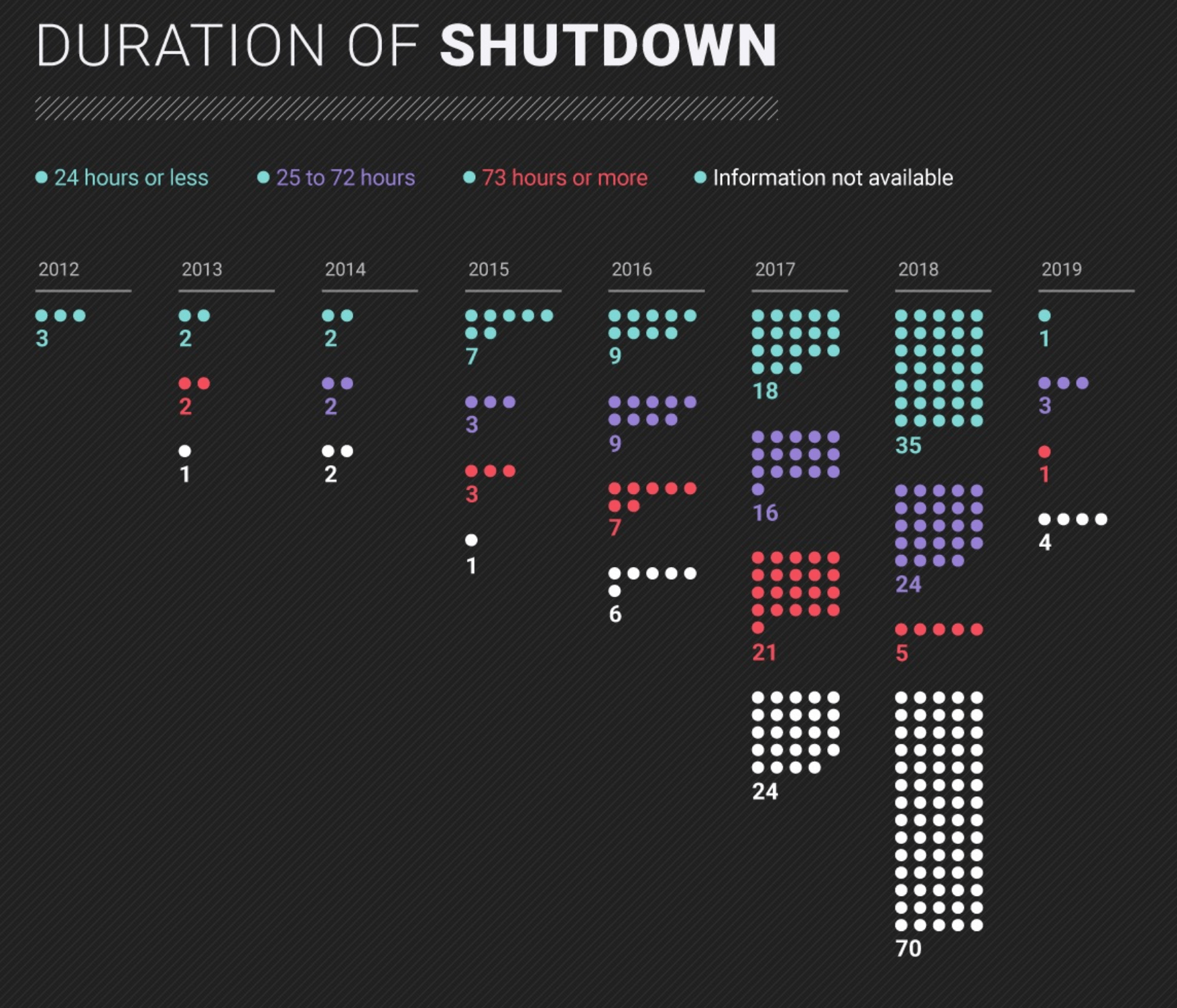

This clearly shows that the number of internet shutdowns have only increased since 2012 in India. If we look at what kind of services were affected
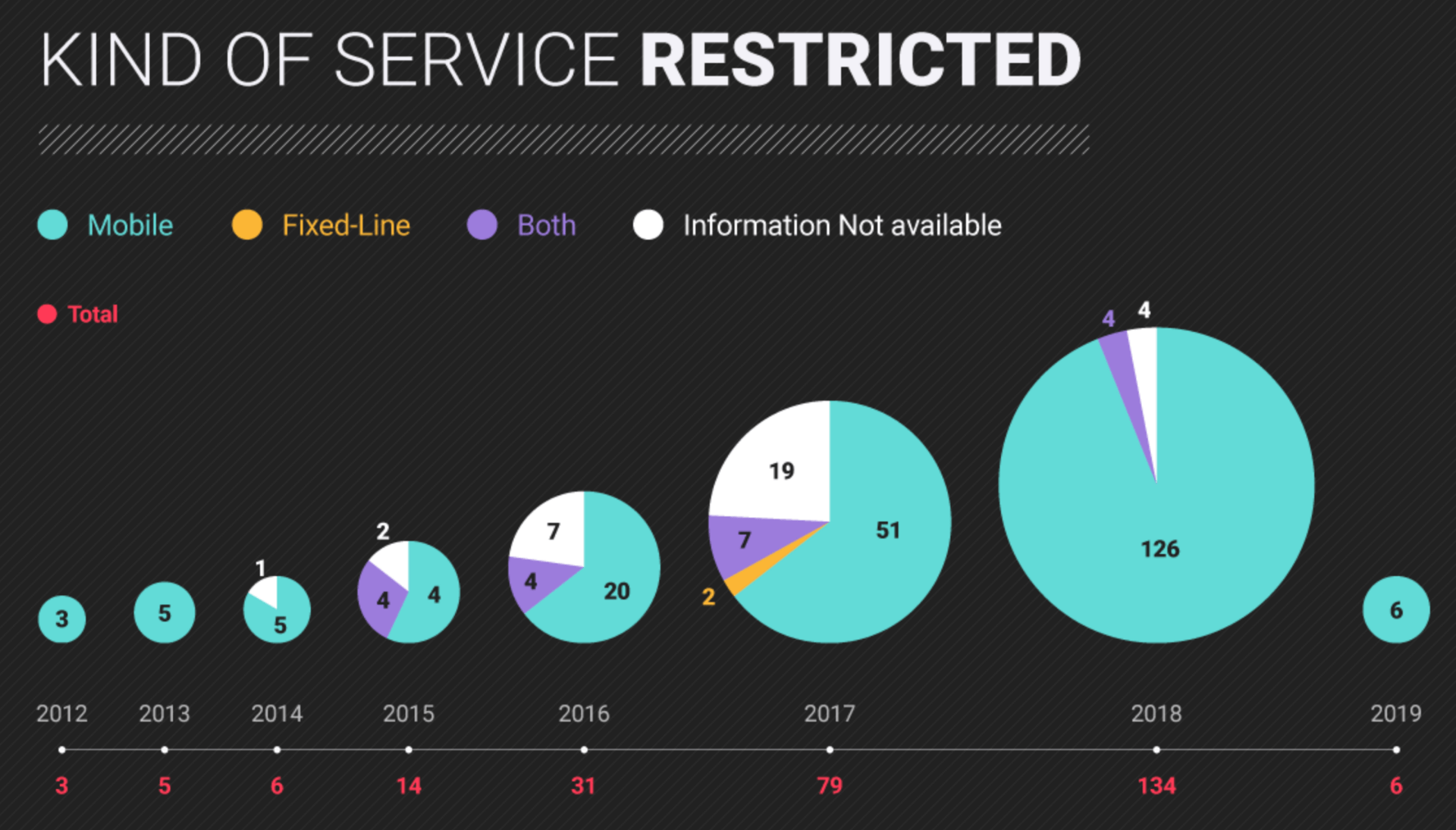

Once we take into account this disturbing trend it becomes clear that censorship and legal avenues are being used to curb freedom of speech. We will take about a potential solution to this in our next post.

If you want to see all the Internet shutdowns till 2018, look at the following document collected by SFLC, where most of the data for this post is collected from. We will talk about our primary motivation and a potential solution in our follow-up blog post


Comments

Popular posts from this blog

Racecraft (Project Koru) · Prologue — The Origin Story

Racecraft · Prologue , The Origin Story It Started With a Wine List and a Question About Racing How a happy-hour conversation in the Bay Area turned into a trustable AI race coach , and then into a second version that runs entirely on a phone, on the NPU. This is the prologue to a five-part series. Two years ago(1st November, 2024) I was in the Bay Area for a GDE Summit. If you've never been: it's a couple of days of talks among Google Developer Experts, the kind of people who get unreasonably excited about a new on-device runtime, and then , mercifully , a happy hour where everyone stops performing and just eats. We ended up at a restaurant(Puesto Santa Clara), a long table of GDEs, and I was doing the most important engineering of the evening: trying to decide which wine to order. Across the table was Ajeet Mirwani . I don't even remember how the wine talk turned into racing talk , these things drift , but the moment the word "racing" ...

The Throughput Trap: Benchmarking vLLM on OpenXLA and the Reality of Production LLM Serving

vLLM Systems · DevLab 2026, Deep Dive I was recently invited by the Google TPU team to speak at the OpenXLA Summer DevLab 2026 . This post breaks down our deep-dive evaluation of the matured vLLM + OpenXLA stack, the fundamental engineering mismatches between CUDA and XLA serving paths, and why traditional capacity metrics are lying to you. If you are operating large language models at enterprise scale right now, your platform architecture team is likely staring at a massive infrastructure crossroads: Should we migrate our core serving workloads from GPUs to TPUs? Historically, NVIDIA's CUDA ecosystem was the only serious option for user-facing, low-latency LLM generation. But here in 2026, the economics and infrastructure options have transformed. Google TPUs are highly available, cheaper per chip, and the open-source serving stack built around vLLM and OpenXLA has officially achieved absolute production readiness. Yet, when our infrast...

A Split‑Brain Neuro‑Symbolic Training Method for High‑Velocity Autonomous Coaching from Telemetry

 Author: Rabimba Karanjai Scope: Problem statement + data methodology + model training (no deployment discussion) Abstract Real‑time coaching in motorsport is a safety‑critical learning problem : a system must map noisy, high‑frequency telemetry to short, actionable guidance that remains physically consistent and avoids hazardous recommendations . This paper proposes a “Split‑Brain” training formulation that separates (i) a semantic coaching target (what action/critique should be expressed) from (ii) a reflexive interface (how actions are represented as compact, verifiable tokens). The approach trains a Small Language Model (SLM) in the Gemma family [1] using QLoRA fine‑tuning [2] , and introduces a telemetry tokenizer plus teacher‑student synthesis pipeline to generate instruction‑action pairs at scale. Core contribution: a reproducible method to convert “ golden lap ” differential tel...