
Today I want to talk a little bit about BrazilJS. The memories are still fresh since it happened just a month back for an action packed 2 days at the beautiful city of Porto Alegre.
Apart from having some of the most awesome speakers I have heard in a conference it had one of the most active and engaged audiences I have seen.
Mozilla had a remarkable presence there, including the captivating talk of Mike Taylor about "How to make browsers compatible with the Web” which I highly recommend you to listen to if you are a web developer or aspire to be one. You will not only benefit yourself from it, but will do a favour to everyone who tries to follow web standards. He gave the same talk in Viewsource just a few weeks after BrazilJS.
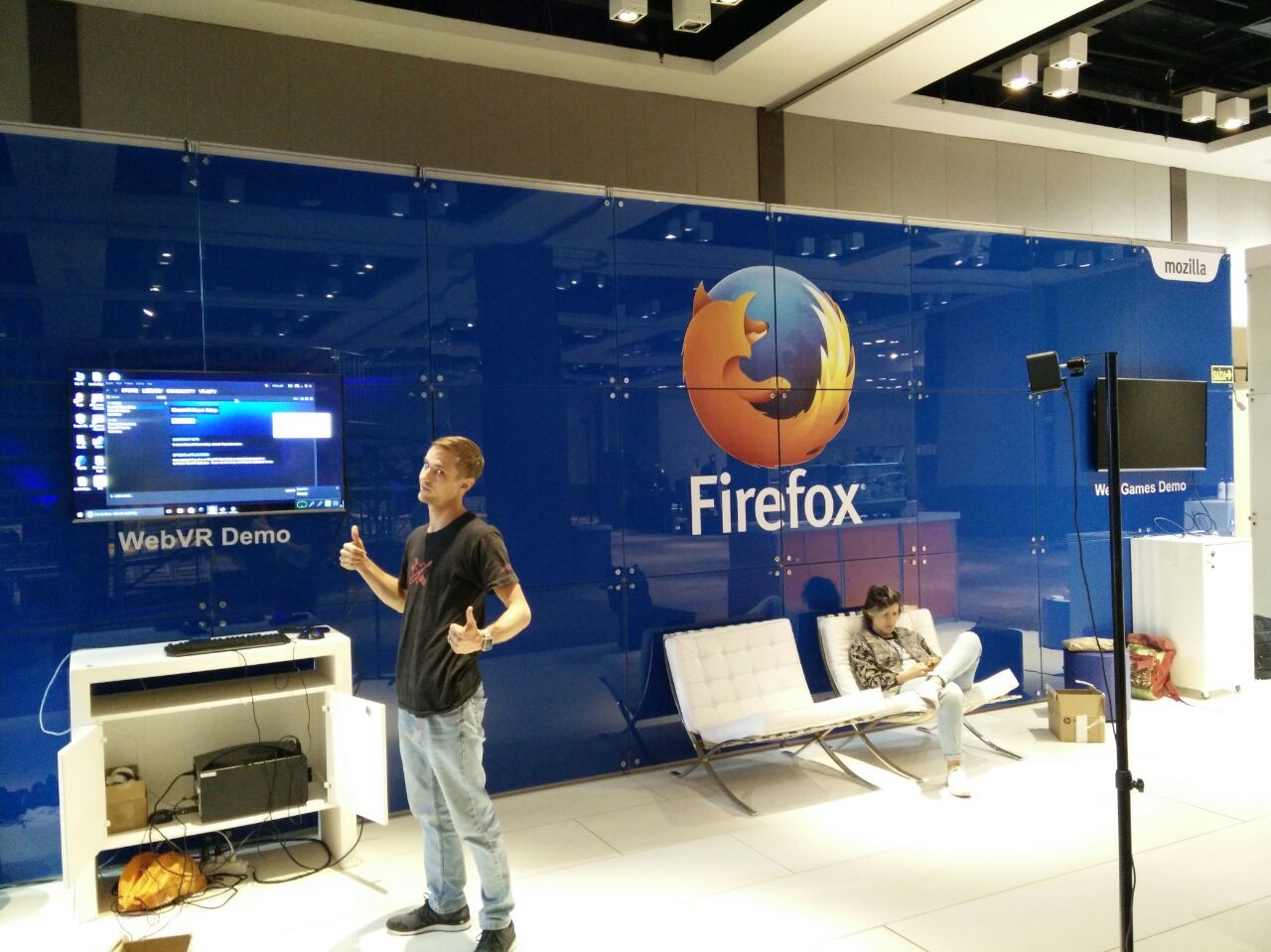
Apart from the talk we had a WebVR and a HTML Game booth set up at the venue, which kind of looked like this when we were setting it up
 |
| The WebVR booth at BrazilJS |
The item up for demo was “Puzzle Rain”. A WebVR game specially tuned for HTC Vive and utilizes it’s controller. In short what you do in the game is to collect different shaped pulsating cubes (each associated with a different tune, so this really is an audio-visual experience) and put them in their appropriately shaped hovering boxes. Each time you perform it properly the tune changes, at the end giving you a soothing feeling of a musical journey.
What was more awesome than the demo and long line in front of the demo booth was the reaction of people while they played the game. Which made them look something like this
 |
| Play in style! |
And remember the long line I talked about?

And when you think everything is over we will always have an awesome performance
That was Nolan Lawson, and how can a web conference complete without Microsoft (Edge) and Mozilla going side by side

And when you say that, how can Google be left behind?
Presenting Mozilla, Microsoft and Google pledging to make the web a better place.
Presenting Mozilla, Microsoft and Google pledging to make the web a better place.
 |
| Mozilla, Microsoft and Google |
But that still is half of what I wanted to write. By now you may have noticed from the pictures that we had an awesome glass wall at the booth. The Brazillian Mozilla community came up with the awesome idea to invite everyone, passionate bout open web to write what they want from the open web and Mozilla on the wall. And the audience, participants, the community as a whole took it up as we see here


Which transformed the wall into something like this

I like to call this a “Wall of dreams”. There are wishes, dreams written in this wall that represents the open source citizens. The “Dumbledore’s army” that roots for open web, a web outside the walled garden, roots for Mozilla to win.
There are wishes written in 7 languages in that wall (including my own which I wrote in Bengali). Can you spot all of them? :)
That’s a task I will leave to the readers.
And at the end this is crew which kept it going in the booth

 |
| And how can we miss your hero Gabriel!!! |
Oh and with the whole team who made BrazilJS and every part of the booth possible
 |
| The Mozilla Brazil Community |
Of course after all these you need a super strong shot of Expresso Rust

And that’s how it all went. At the end, of-course our very own superstar Michael Ellis had to steal the show
This is how we wrapped up #BrazilJS
Comments
Post a Comment